
Good Luck, Have Fun, Don’t Die Drowns in its Own Creative Pool

OPINION
Review by: Juan Drown
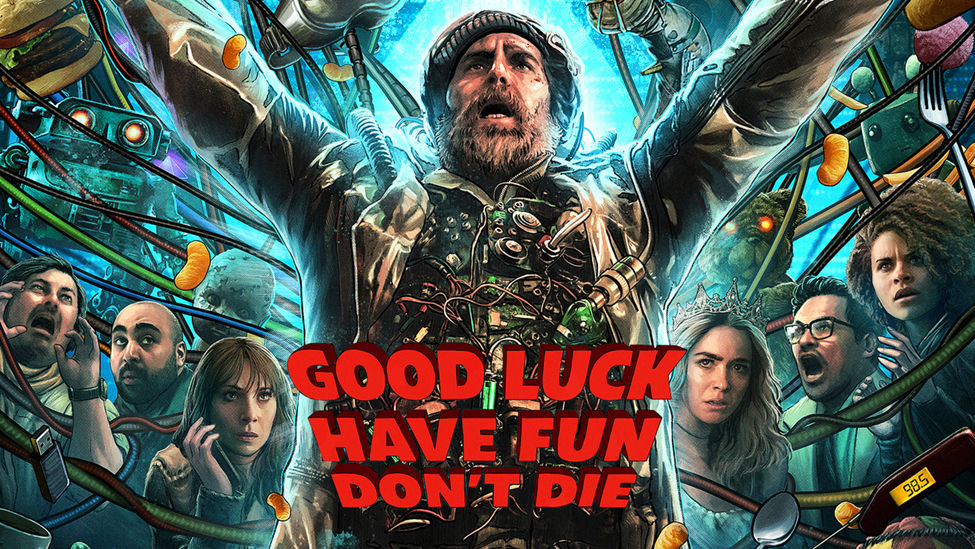
“Good Luck, Have Fun, Don’t Die” is director Gore Verbinski’s stylistic return since his last feature, “A Cure for Wellness” (2016). It follows “The Man from the Future”, portrayed by Sam Rockwel, who is hellbent on saving mankind from extinction by the ultimate villain — Artificial Intelligence. The Man from the Future uses a self-made time-travel suit to repeatedly return from the future to our present to recruit a ragtag team to implement safeguards on the A.I. before it gains sentience.
The film’s premise is a mix of “The Terminator” (James Cameron, 1984) and “Everything Everywhere All at Once” (The Daniels, 2022). Rockwell plays The Man from the Future with an off-kilter eccentricity. He uses information he learned about the restaurant patrons during visits to alternate timelines to convince them he is from the future. He recruits a team of misfits; two teachers on the run from students turned into mental zombies from watching too much TikTok, (Michael Peña and Zazie Beetz), a grieving mother of a school shooter victim ( Juno Temple), and a mysterious suicidal princess (Haley Lu Richardson).
A third of the film’s runtime is devoted to these dystopian Black Mirror-esque insights following the film’s misfits–the teachers, the mother, and the princess–as they struggle to connect in an increasingly disconnected society due to technology. Despite the filmmakers’ attempts to connect us with the characters, the viewer is left largely indifferent to their struggles and whether they live or die. Not enough nuance is given to them as actual characters, and they come off as stilted caricatures.
Verbinski is too focused on the extreme consequences of an increasingly technologically dependent society. The insights serve as his commentary: he pushes doomscrolling and A.I. to absurdly dystopian heights. Verbinski comes off as increasingly absurd in his vision of the future, using doomscrolling-addicted teens to kill their teachers and a confetti-urinating cat-taur.
Matthew Robinson and Verbinski aim to leave viewers with a strong anti-A.I. message. Still, Verbinski’s message gets bogged down in his creative scenarios, leaving the film feeling vapid. In the end, the film is technically well-made and entertains viewers, but just like A.I., once you peel back that glossy surface, it is vapid and has no real significance.


